So, What Is This All About?
Well, it's been a very long time since I've written anything like this.
And, to be totally honest with you, I'm not really sure where this is going, whether it's worth your or my time, and even if I really have all that much to say.
But, I do have some time on my hands, so I figure I'll give this a try.
Thinking ... And Writing ...
I've been spending much less time, no time really, on Twitter in recent weeks.
Twitter, with all its faults, is a place where I: a) get exposure to a lot of stuff that is going on in the world; b) get links to things that are being written about what's going in the world; c) hear what a lot of other people think about what's going on in the world; and d) write down some of my own comments in response to everything I've noted in a, b, and c.
Like all of you, I continue to follow the events of our worlds.
But, without going to Twitter, I'm neither paying as much attention as I normally would to the writing and comments of others nor am I adding any of my own thoughts to the public conversation.
This experimental return to this blog, at this particular moment in time, is my effort to resume my participation, albeit from a bit of a distance.
In what follows, then, I'll offer some thoughts I've been having in response to 3 things that are are currently marking the worlds in which we live.
If this works out well, I'll try to do this on a semi-regular basis, addressing newer events, and presenting my thoughts, that arise.
If you feel like engaging me in conversation on any of this, I'm sure you'll figure out how to find me, even during my current Twitter hiatus.
So, and with sincere apologies in advance, here goes...
Thing #1: Covid-19 and Quebec's "Policy" for Back to School
 |
| Back to school in Quebec. |
Full Disclosure: I have a daughter who's recently just returned to grade 8 here in Montreal. My thoughts on this thing are based almost exclusively on this personal starting point.
When it comes to Quebec's policies for back to school, as applied to high schools in the public school system, my main conclusion is that the government's plan for the mitigation of risks associated with Covid-19 is really plan that ensures very little in the way risk mitigation.
Two weeks in, here are some highlights of what's been going on:
- 33 students are packed in a classroom.
- There are no plexiglass separations either between students or between teacher and students.
- There is no mask mandate within the classroom.
- There is no physical separation between students in the corridors.
- There is no real enforcement of designated entries/exits to and from the building.
- There is dense social and physical interaction between students on the school grounds and on nearby neighbourhood streets.
- School administrators are prohibited from "adding to" or "augmenting" measures [sic] that have been implemented by the provincial government.
- Young people are traveling back and forth between their home/community-based activities (sports, dance, regular old socializing) and their suddenly refreshed parent-free networks at school.
- My daughter reports that the number of students electing to wear masks in her class is on the decline.
- My daughter's friends are telling her about cases of Covid-19 that have been identified at other schools in the city.
As of this week, students are allowed to participate in out-of-class extracurricular activities at Quebec schools, seeing their interactions expand from from those occurring within one class bubble to include sports and other activities that will now be able to take place in two additional bubbles.
With this change to Quebec's policy, the integrity of the single principal measure that was put in place to reduce possible pathways for virus spread in schools will have been significantly eroded.
I don't blame young teenagers for enthusiastically coupling their return to formal learning with the re-establishment of their valued social ties and routines.
I do blame our political leaders for not pouring more resources into the school system in order to give education professionals a real chance to establish and implement the temporary emergency measures that are needed to address the local manifestations of a global health crisis.
I also blame our political leaders for not being able to confront the parents in this province with tough, inconvenient, but needed messages and limits that must be put in place to have a higher chance of ensuring the health and safety of their children, their friends, their families, and members of their wider communities.
Thankfully, our political leaders did tells us citizens that, for the good of the community, we are obligated to wear masks if we enter public buildings or stores.
But, they do not have the smarts or guts to extend this sensible logic to the treatment of our children who are now assembling and interacting in large numbers for many hours every single day, in every single neighbourhood, in every single city and town in the province, in our public schools.
The math is not unknown.
We are knowingly participating in a dynamic that we understand, whose social and health consequences we both fear and can predict.
We have knowledge and reservations about the future consequences of the actions we're taking today, but we act as though we are powerless to influence the outcomes.
It is a government-led plan for the mitigation of risk that ensures that we're doing very little in the way of actual risk mitigation.
Thing #2: Trump and his Vaccine October Surprise
There are so many thoughts that I can express about the Idiotic President, and about the way we interact with him, but I am going to keep this limited to a relatively tight focus on the question of whether the US will release a Covid-19 vaccine this fall.
 |
| Donald Trump promises a Covid-19 vaccine by October. |
Sitting at the heart of this issue and all the chatter is whether Donald Trump stands to reap electoral rewards were a Covid-19 vaccine to be developed and distributed under his watch.
Come on!
With polls showing that the majority of US voters view the Covid-19 pandemic, and the current administration's handling of it, as the top issue heading into November's election, and with the consequences of the pandemic expected to be felt by communities across the US for many months (possibly years) to come, is the arrival and distribution of a vaccine to targeted populations in the weeks and days prior to election day likely to move the needle on decisions that will be made by key voters this time around?
Put more directly, based on everything that you know about his presidency, and based especially on the fact that, to win in November, Trump desperately needs to capture the swing voters in the battleground states that are apparently open and willing to vote for Biden, is a vaccine arrival in October really likely to be a factor that will help him to secure to 4 more years in the White House?
I don't think so. Here's why.
For a voter who is favourable towards the Trump presidency, and who therefore most likely believes the president has handled the pandemic well, the arrival of a vaccine in October or early-November will only be icing on the cake.
Thinking about this group of voters, the fact that many of them are likely to be unafraid of Covid at best and possibly aligned with the anti-vaxxer crowd at worst, the presence or absence of a vaccine is basically irrelevant as a push factor in favour of voting for Trump.
For Trump opponents, well, this thought doesn't even require elaboration.
To the extent that they do exist, perhaps there are questions to ask about those Trump supporters (Republicans or independents) who do admit to seeing some amount of pandemic mishandling by the president.
Assuming, for example, that these voters continue to celebrate Trump's approach to the economy, law and order, and/or his adoption of a slew of causes and quasi policies that are meant to advance the case of White grievance, would the arrival of a vaccine before November push them to ignore his failure to promote a national mask mandate?
Will a vaccine breakthrough assuage their frustration over the fact that Trump has totally shut Anthony Fauci out?
Will an October vaccine surprise be enough to lead these voters to simply laugh at the fact that the incumbent president both asked Americans to treat themselves with bleach and also claimed to have taken hydroxychloroquine?
It is certainly possible that for some of the swing voters that Biden and the Dems are counting on, the arrival of good news regarding a US-made Covid-19 vaccine in October may reinforce their already existing willingness to back a second Trump presidency.
In the face of everything that is going on in American society and culture today, however, and given the verifiable role that perceptions about other volatile issues (Hint: law and order in America's streets) will play in determining whether swing voters will take the plunge for Biden, it is just hard for me to believe that anything Trump does or claims to be doing regarding a vaccine between now and the election date will be the decisive factor determining in deciding the election.
This thing just reeks to me of being a juicy media storyline to get people all riled up, but one with not that much in the way of real substance.
Thing #3: Athlete Protest, Black Lives Matter, and Systemic Racism
 |
| Milwaukee Bucks boycott a playoff game against the Orlando Magic. |
With a few notable exceptions, mostly in the WNBA, this plan didn't get off the ground.
Instead, and seemingly encouraged by some of the NBA's biggest superstars, most of the players came to the conclusion that they could have more of an impact on the fight to address systemic racism in America by playing and by using the massive public exposure they'd get during this time to boost their advocacy for social change.
In the time since the MLS, NBA, WNBA, MLB, NHL, pro tennis, and now NFL, returned to play in wildly unusual competitive conditions, players and teams have kneeled during national anthems, stayed in locker rooms during national anthems, presented protest oriented messages on their uniforms, locked arms in solidarity with their opponents in the field of play, and even boycotted games and matches following the shooting of Jacob Blake.
While there have been some awkward and more highly embarrassing moments along the way (hello, NHL!), it is now largely recognized that we're living in a time in which pro athletes are declaring and showing that they will not have their identities as active members and citizens of their communities eclipsed by their roles as sports stars and celebrities.
In this high-intensity moment, and quite different from how things were not so long ago, nobody appears to have the power, or even any inclination, to try to stop pro athletes from acting forcefully on the basis of their social and political interests.
Put simply, it is currently recognized that this is just no time for pro athletes to stick to sports.
 |
| Naomi Osaka returns to play after boycotting her Western & Southern Open match in protest against police brutality. |
These are extraordinary times.
But, tapping into an earlier period in my life when I was trying to become a scholar of social movements, and most definitely with awareness that this is coming from the privileged safety of my own home, here are a couple of questions I've been asking myself:
Is the widespread presence of protest language and activity in this unusual zone of Covid-era professional sports actually a good thing for the larger movement that is mobilized in support of Black lives?
Is the near universal support being offered to the athletes by pro sports leagues, team owners, corporate sponsors, commentators in the media, and by fans helping to target and eliminate systemic racism in North American society?
Despite the excitement and potential that I do feel and see right now, I'm also not yet fully optimistic that the answer to these questions is a clear yes. Let me explain why.
Let me begin by returning to the anecdote with which I started this section -- the plan, ultimately not collectively carried out, by athletes to refuse to return to play in their leagues and to engage in social justice advocacy instead.
I don't know about you, but this plan excited me.
Yes, the sports fan inside me would have been a little bummed. But, in terms of focusing the public's attention on social issues, and in terms of seeking a mechanism to exact leverage on powerful societal actors actors in an effort to get them to pay attention to and to take action in support of a cause, holding out services from professional sports leagues while simultaneously pushing them to join you in challenging systemic racism against Black lives sounded to me like a dream movement scenario.
You might come back at me now and say that since all of this stuff is pretty much happening anyway, why should the players have held out?
While it's definitely true that leagues, commissioners, and team owners are mostly responding favourably to pro athlete protests, and that they're also taking some nice and surprising (hello, NASCAR!) steps to address movement concerns in their own communities, just how far will these initiatives go in tackling systemic racism against Black folks and other racialized minorities in North America?
The removal of Confederate flags is good. The elimination of racist team nicknames is long overdue. Creating more spaces for voting in cities is a great thing for democracy. Seeing pro athletes as complex human beings with opinions and concerns about their surrounding worlds is a giant win on its own.
But, despite the undeniable importance and significance of these outcomes, the relative ease and speed with which what has to be described as sanctioned athlete protest has been able to push the leaders of pro sports leagues to acquiesce on an array of issues, many of which had been under discussion for years, leaves me with a nagging question about the potentials of a more socially disruptive course of collective action tactics:
Just how much more could pro athletes help to achieve if they were to revisit that initial conversation, collectively withhold their labour, work directly with regular folks in calling attention to ongoing social grievances, and refuse to return to work until or unless team owners, league officials, sponsors, members of the media, and even fanbases were compelled to join them in pushing business and political elites at the local, state, and national levels to enact policy changes that are needed to more deeply overturn the racist status quo?
It is most certainly not the responsibility of pro athletes to lead today's movement in support of Black lives. It is, however, wildly intriguing to imagine the breadth and depth of the outcomes that could be achieved were they to do so.
There's one more hesitation I have about the efficacy of today's athlete protest.
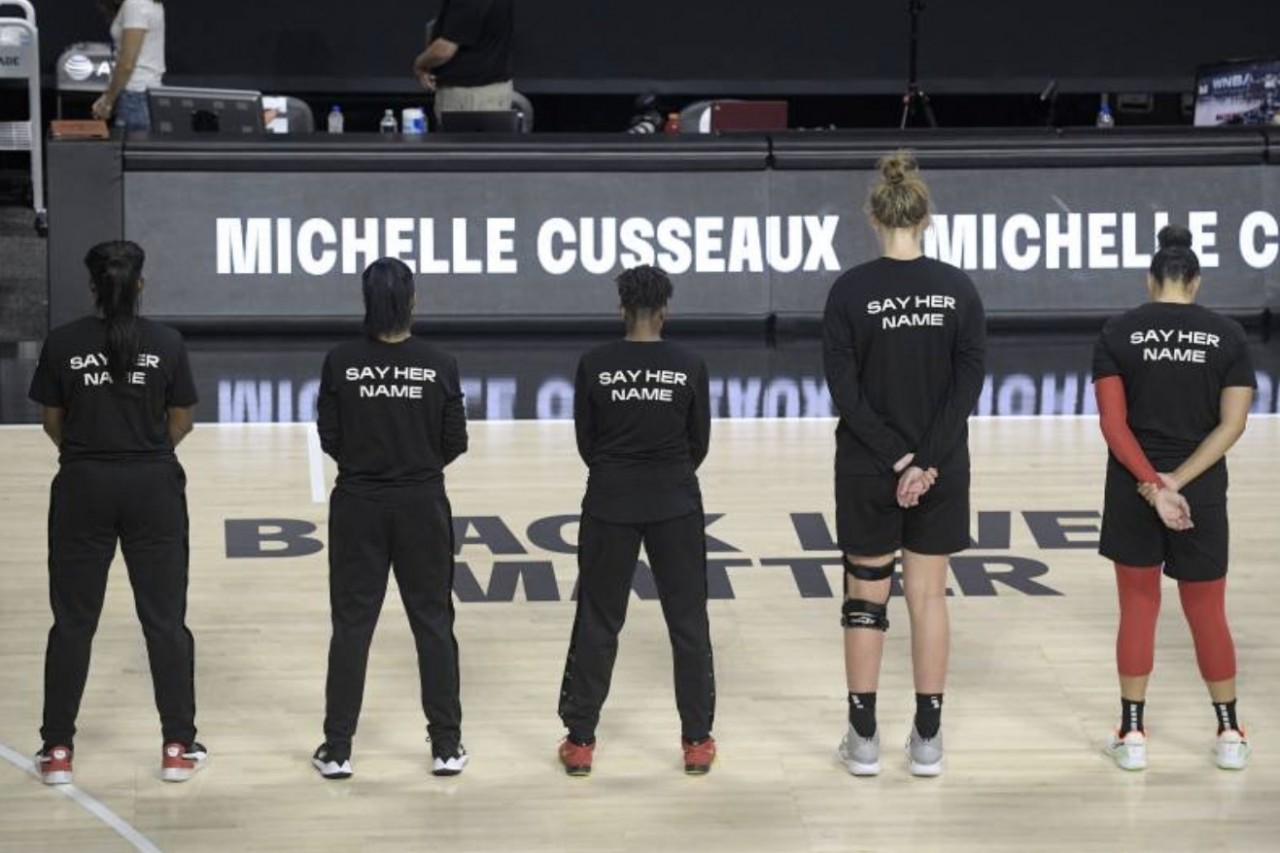 |
| Players on the Atlanta Dream in protest. |
While we're definitely seeing a very high degree of support for today's athlete activism within North America, from a social movement perspective, there's paradoxically also something a little problematic about what appears to be rock solid societal agreement regarding the appropriateness and necessity of this wave of protest.
Despite the appearance of widespread consensus, we also know that no constituency of any kind is monolithic. And, from owners to fans to players, it's clear that not everyone is 100% on board with the predominant messages that are being expressed and with the actions that are being taken.
Now, you might think I'm raising a concern about the actual degree of consensus within and surrounding today's pro active protest.
No!
In fact, I'm arguing the opposite point.
I'm saying that rather than consistently presenting a message of resounding unity regarding the protests and the social issues that they're meant to highlight, it might truly be better for today's racial justice movement if there were to be more direct and extended public elaboration on the matters, ideas, and movement goals about which the pro athletes, regular citizens, and societal elites sincerely and vehemently disagree.
 |
| Kelly Loeffler, Co-Owner of the Atlanta Dream. |
Now, I'm not saying this because I hold a very fine people on both sides position on this.
No!
I say it because I believe that in order for there to be progress in the fight to support Black lives and to end systemic racism in North America, there has to be direct confrontation with and dismantling of the actual racist social conditions and cultures in which we live. And, because large segments of the population (including plenty of political, business, media, and sports industry elites) resist the very idea that White folks continue to perpetuate and benefit from actual racist social conditions and cultures around us, it's inevitable that there will have to be serious disagreement and discord between citizens in North America on the long journey of actually confronting and dismantling those conditions and cultures.
We celebrate and feel good about the recent polls that show increased support for Black Lives Matter and for the rights of athletes to protest in and around the field of play, but there will be a lot of social acrimony as more people take more actions to chip away at and eliminate White supremacy.
We will most certainly NOT all agree as varying conditions of discrimination are highlighted by our work colleagues, friends, and casual acquaintances in their efforts to have their existence acknowledged.
We will most certainly NOT feel unified as our neighbours, politicians, and artists work on critiquing, sharpening, and refreshing our societal values and norms.
We will most certainly NOT arrive at a complete and harmonious consensus as we continue along through the challenging process of realizing that only one side in the so-called there are two sides to every argument equation can be adopted as the anti-racist side.
And, while it's easy to say that the bulk of the heavy conflict over will arise between conservatives and liberals in North America, dismantling today's manifestations of racism will animate significant disagreements and discomfort among those who most reflexively count themselves as supporters of the movement for racial justice as well.
From media to politics to sports, there's no shortage of folks who'd undoubtedly describe themselves as pro-diversity but who've nevertheless found themselves forced to reckon with how their actions and ignorance of their own privilege brought them to do more to reinforce race-based inequalities than to turn them upside down. Their personal journeys to gaining higher levels of understanding and empathy attest to the fact that confronting and working to reduce and eliminate racism and inequalities in our communities and in our society as a whole is anything but tension and conflict free.
The protest actions in today's pro sports duly draw a lot of our attention and support. They are achieving some important cultural gains, and they are pushing the envelope in terms of the political and social identities by which athletes are being recognized.
It is, however, the safely consensual features of both their tactics and their anti-racism discourse that currently puts some unfortunate limits on their current potential to act as a movement for deeper social change.
